






Our business in life is our story, our offering, our information, beliefs, ideas, thoughts, feelings, and actions, and how we give of our cells to others and the world around us. A balanced cell lives in service to self and to others, a balancing act and dance between the giving, receiving, and neutral states the cells experience to charge, reset, release, rest. And how you are giving of your time, energy, and cells, and who you’re giving it to, and where you’re giving it, and how long you’re giving it, will all play an effect on your self-worth, health, wealth, happiness, and relationships.
Every avenue of life is an energy; you’re not only giving your self-worth and inertia to, but you’re also choosing to receive from it — time, energy, finances, relationships. The idea that our personal and business are separate is one of the unhealthy paradigms from the rat race, heavy on the patriarchy, with an entrée of compartmentalizing and separating for dessert.
The lack of connecting your personal to your business is also a representation of the belief systems within. A sign you’re not tying together, what’s going on inside and what’s happening outside as a result. That releases all self-responsibility/cell power which takes one out of generating their own energy and the need for other(s) to host off of. When one isn’t willing to apply their own pressure, generate their own routines, schedule, healthy patterns, create their own offerings — it is a tall sign one is stuck in consumerism, not creation. Just like jobs, business, careers — who and what are you giving your energy to, and what is your reason why? The idea of money, success, society, image, control, respect… find your rooted belief systems.
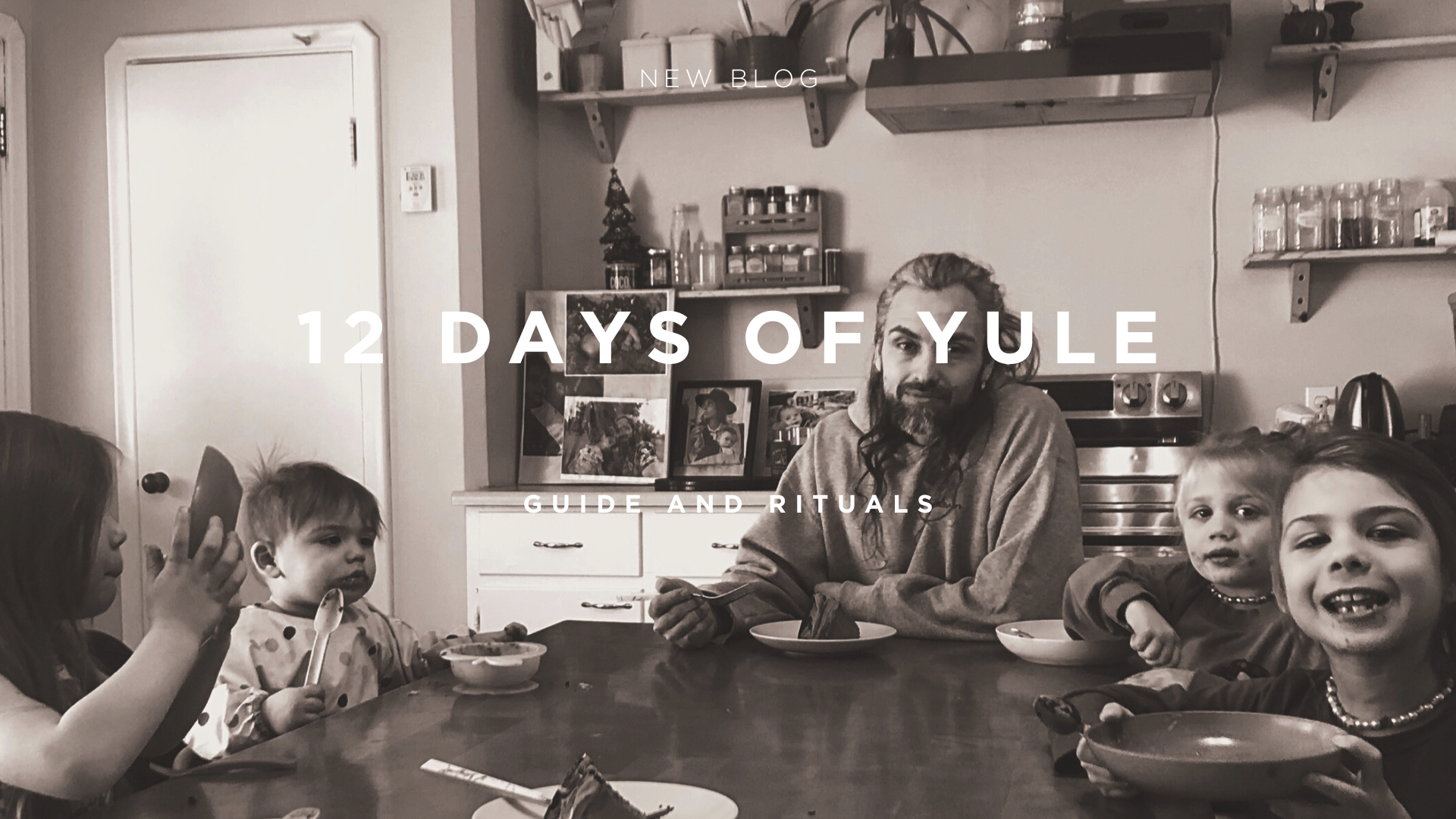
Why I’m just sharing this is because it’s really our family’s first year of focusing on the 12 Days of Yule — It’s not something we’ve done every year, intentionally. Lots of practices and rituals have been done throughout my life organically, which is very validating to our connection to our roots and what pushes and pulls us. And with that said, I only teach what I practice multiple times and truly have trialed it — If I’m not doing it consistently, I won’t share it. I’m not seeking that attention or validation; I share because I care and want to inspire, and only share if I’m inspired, which keeps my social media genuine and real to the healing journey — you can see when I’m turning inward, you can see the stages of my evolution, you can see the periods of time when I didn’t go on at all, all apart of my own life journey in releasing the image and script, and practicing what I learn before teaching it.
I want to be true to myself; cells always keep it real, that’s the only way one can truly deal with all the complexities of our human nature. Don’t get your cells twisted; and edit, copy, steal, alter, along the way, you’ll just confuse yourself/your cells into a life that isn’t real by giving all your energy to keep the facade. One pop of the bubble , you’re exposed, so you control the narrative and keep the truth speakers out — the parts of the self that haven’t risen out of competition and comparison, separation, compartmentalizing every area of their life, not looking at the other or others.
It’s been trying to crack through, the larger picture, the origin, the roots, through the years of commercialized, superficial ideals and actions, celebrating lost traditions, never knowing the root, just following the status quo, societal norms, and expectations. My Celtic, Germanic, Russian, and Norse ancestors’ practices and rituals alive in my blood and cells, Fichter, Funke, McGrath, Kofoed, the four pillars of my foundatION pulling me to pick up where they left off, where they sold out, or were stolen, suppressed, scared into silence, trampled... and not just my own, but a blend with Johnny’s,(which we are still gaining clarity on as he rejects going into his ancestry (which is information in it’s CELL), Spand an understanding of our biracial connection, bridging cultures, biodiversity, the light and dark, the yin and yang. Through all this self-study, life makes so much more sense — what we experienced and why, and how we want to raise our children, and what lifestyle we need/want to live to thrive, out of unhealthy cycles and patterns passed down from cell to cell.
In ancient times, this liminal space—neither old year nor new—was during the 13 month of the lunar calendar. It was a time for essentially for connecting to self, family, craft, feast, rest, gift-giving, ritual, conservation, decoration, and pleasure .
A time to:
- Connect to your roots/ancestry
- Honor your cycles
- Embrace the feminine
- Break free from "race" patterns
- Align with your true path
Let's dive into the 12 Days of Yule celebration!
They’ve been edited, altered, borrowed, modernized so with that said this isn’t going to be completely accurate and they’ll be contradicting information and different lists for the 12 days and how they’re to be spent depending on origin. I didn’t include the full stories just excerpts from so I always strongly encourage one does their own research to activate their mammalian brain and second dimension taking their self and nervous systems out of states of survival.
My own family will base the days off of what resonates with us. I’m certain it’ll evolve and shift slightly over the future years as we get more established in our traditions and roots. The 12 Days of Yule begins. In ancient times, this liminal space—neither old year nor new—was for connecting to self, family, craft, feast, rest, gift-giving, ritual, conservation, decoration, and pleasure . A time to:
- Connect to your roots/ancestry
- Honor your cycles
- Embrace the feminine
- Break free from "race" patterns
- Align with your true path
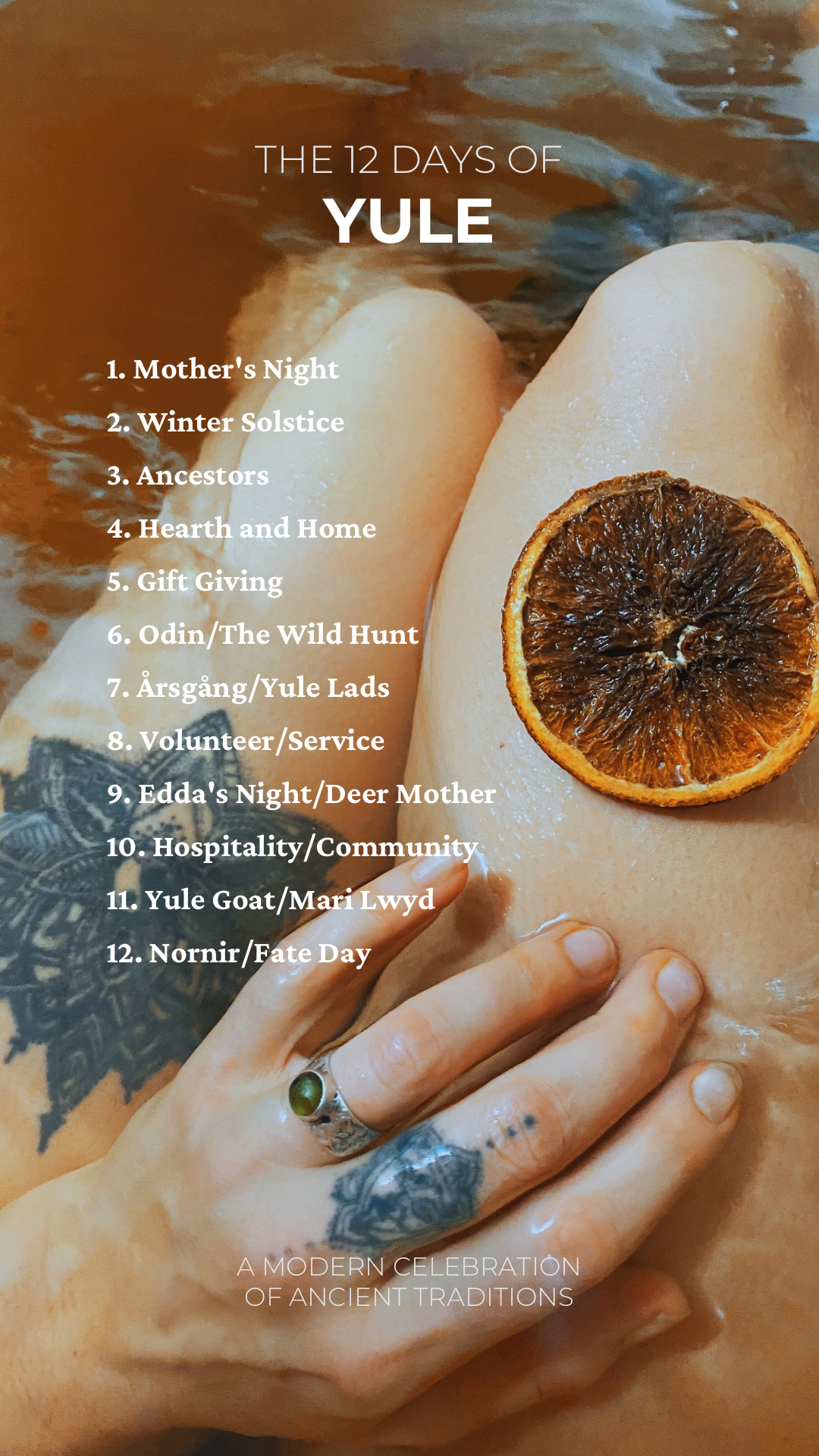
How to Celebrate the 12 Days of Yule
If you’d like to work with the 12 Days of Yule, first decide which days you’d like to include. Which ones speak to you? Are there other themes, deities, or beings you’d like to work with or honor during this time? Would you like to build a Yule altar, burn a Yule log, or simply journal about the themes?
Here's a gathered breakdown from multiple sources and sites for each day and some tips to honor them:
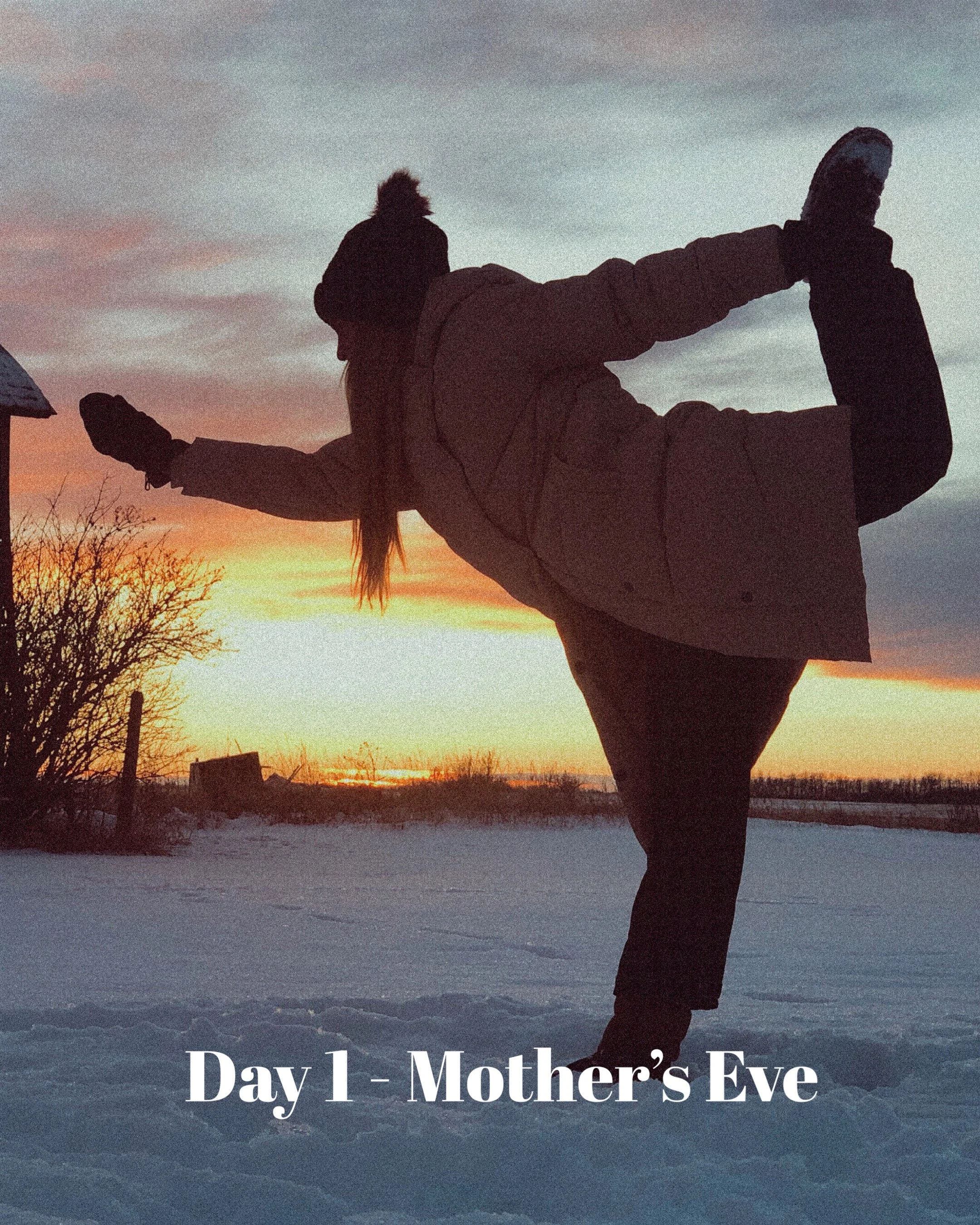
Day 1: Mother's Night/Mōdraniht (December 20) This 12 Days of Yule calendar begins with Mother’s Night (Mōdraniht) because it’s the oldest historically attested midwinter ritual in the Germanic world.
Mother’s Night can be a moment to work with the Goddess or any other female deities, or a time to pay homage to the literal women in your life who have shaped you into who you are today. These could be your actual family, your chosen family, or your ancestral line.
- Honor the divine feminine by lighting candles and making food offerings to goddesses like Frigg or Gaia. - Reflect on the women in your life and their impact on you.
Leave an offering that aligns with the female deities you work with.
Cook a meal using a recipe from your maternal line.
Tell stories that center around the important women in your life
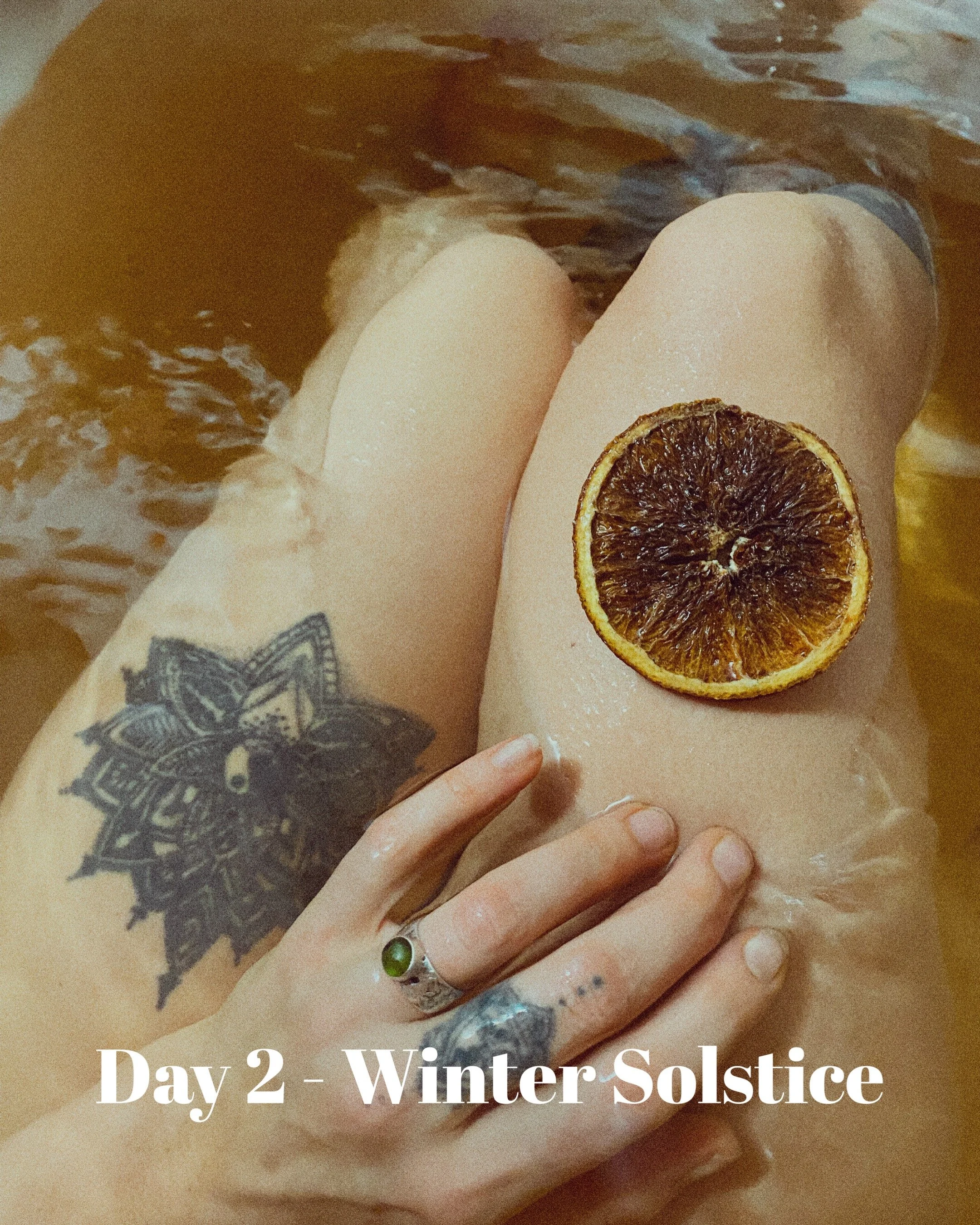
Day 2: Winter Solstice/Jólablót (December 21)
The Winter Solstice is the longest night of the year and the next morning is the turning point when the Sun begins its gradual return. For ancient cultures, this moment carried enormous symbolic weight: the victory of light over darkness, the renewal of cosmic order, and the reassurance that winter would not last forever.
The Jólablót was the centerpiece of Yule. It involved a sacrifice to Freyr, the Norse god of fertility, peace, and prosperity. It also included a giant feast and oathmaking, known as the Bragafull.
- Cleanse your space with sage or cedar to welcome new energy. - Set intentions for the coming year and plant seeds for growth.
Take a few moments to simply breathe and appreciate both the sunset on the Solstice and the sunrise the next morning.
Light a white or gold candle at sunrise to welcome back the Sun.
Leave an offering of for the gods, goddesses, and dietes
Journal about what you are ready to leave in the darkness and what you want to bring into the light and expand.
Eat or share round foods (oranges, rolls, anything sun-shaped) or any Yule recipes as part of a holiday feast.
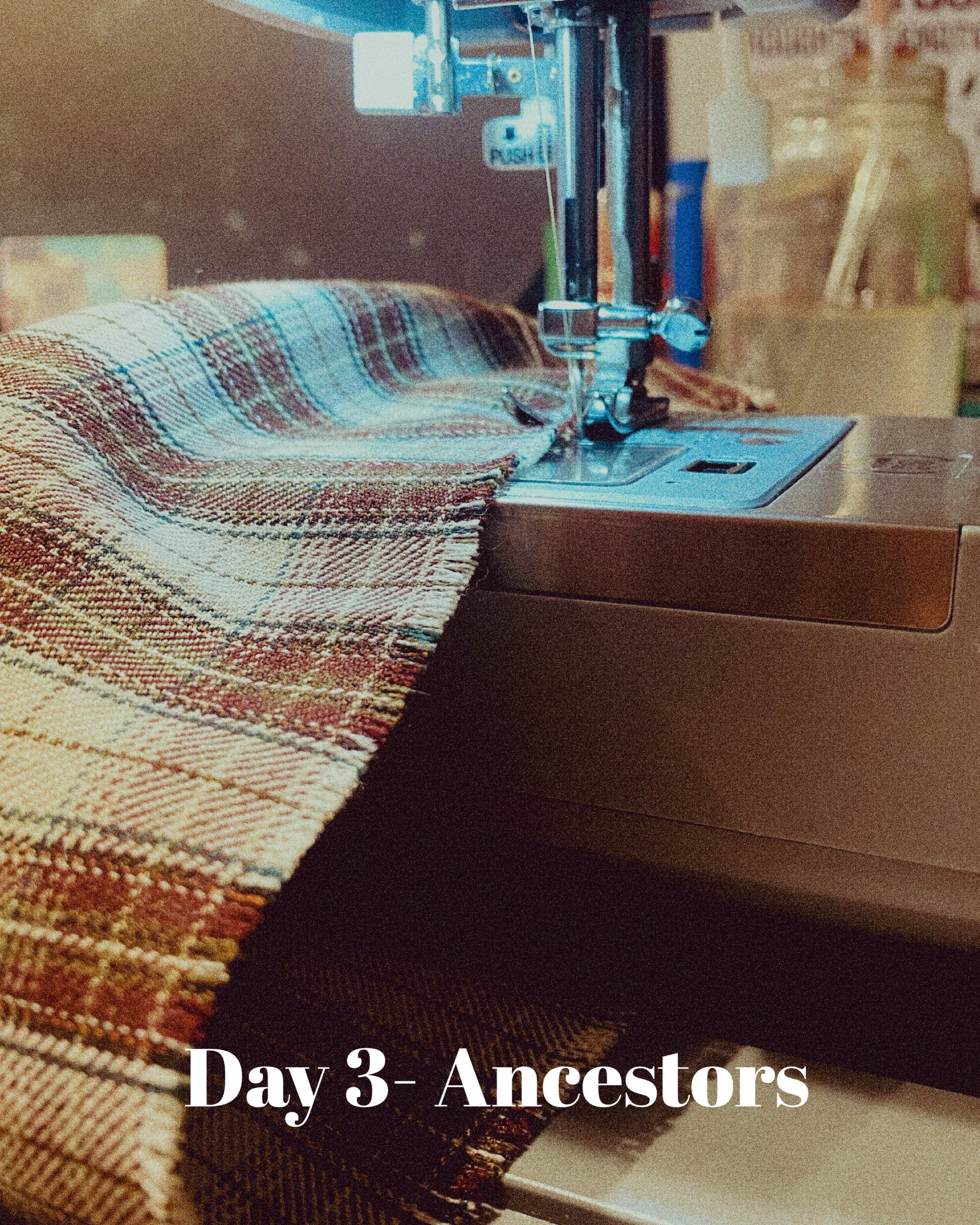
Day 3: Day Of Ancestors/Honoring the Vættir (December 23)
Yule is a time for family gatherings, and it’s also a time when we remember those who came before us. Whether that’s the family and loved ones you knew who are no longer with us, or you want to honor those further back in your ancestral line, Yule is an appropriate time to do this.
In Norse and broader Scandinavian folklore, the vættir are spirits of the land and home that protect, bless, and interact with humans if treated respectfully. These spirits were honored with offerings at seasonal transitions, especially at Yule, when the veil thins and household luck for the coming year could be secured or lost.
-Light a lantern or candle outside or on a windowsill as a sign of welcome. Battery powered for safety is best instead of an open candle.
Acknowledge the spirits with a few words and request for protection or blessing.
Don’t make loud noises during the night. Traditional folklore warns this may offend the vættir. And your neighbours.
- Honor your ancestors with an altar, photos, and offerings like bread or wine. - Share stories about your loved ones and their legacy.
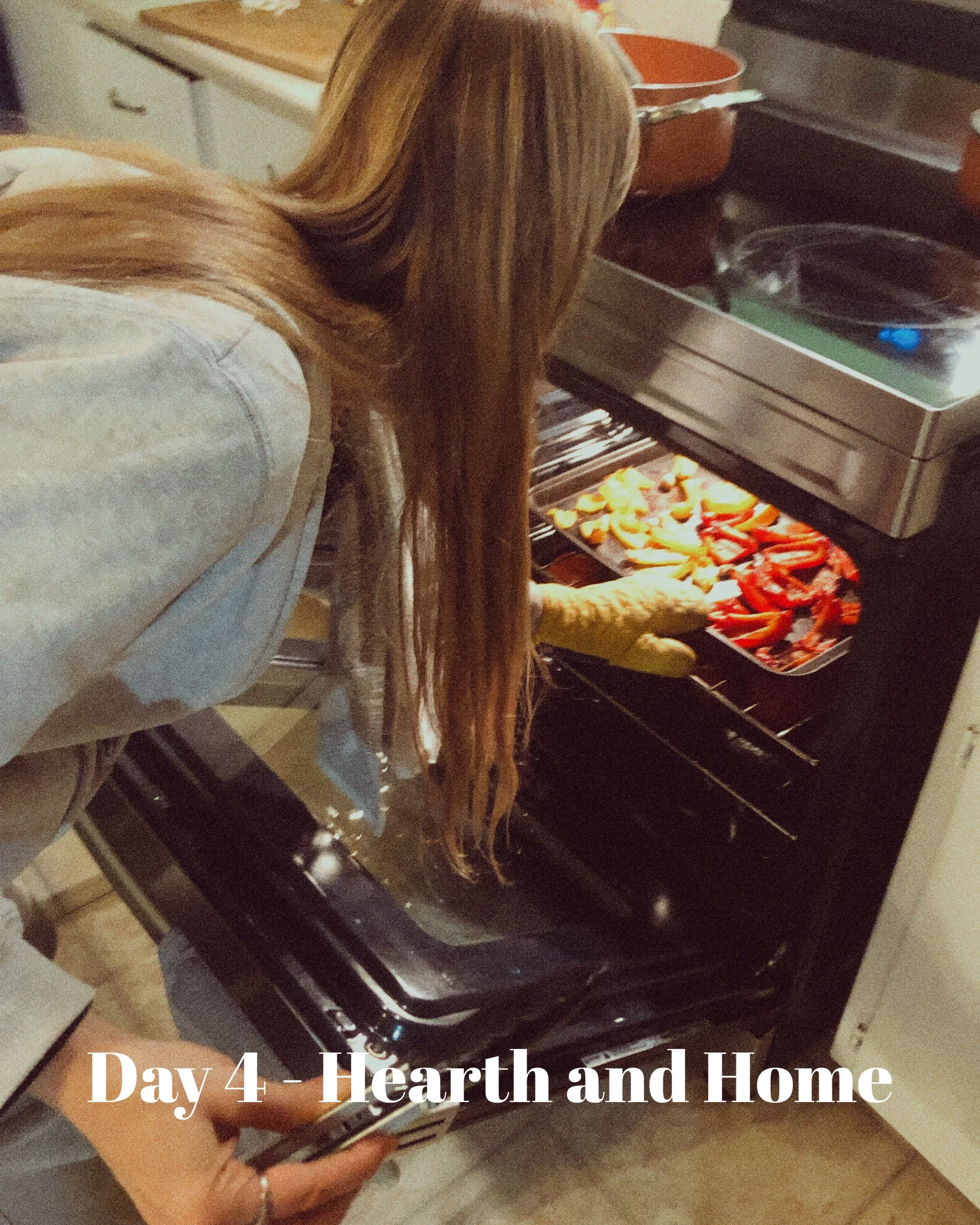
Day 4: Hearth and Home (December 24)The hearth was the spiritual and literal center for ancient pagans. And, in winter, it was even more important. It was the place where the family cooked the meals, dried the clothes, burned the Yule Log, and gathered around to stay warm.
- Focus on warmth and protection by lighting candles and sprinkling salt around doors. - Cook a nourishing meal and share it with loved ones.
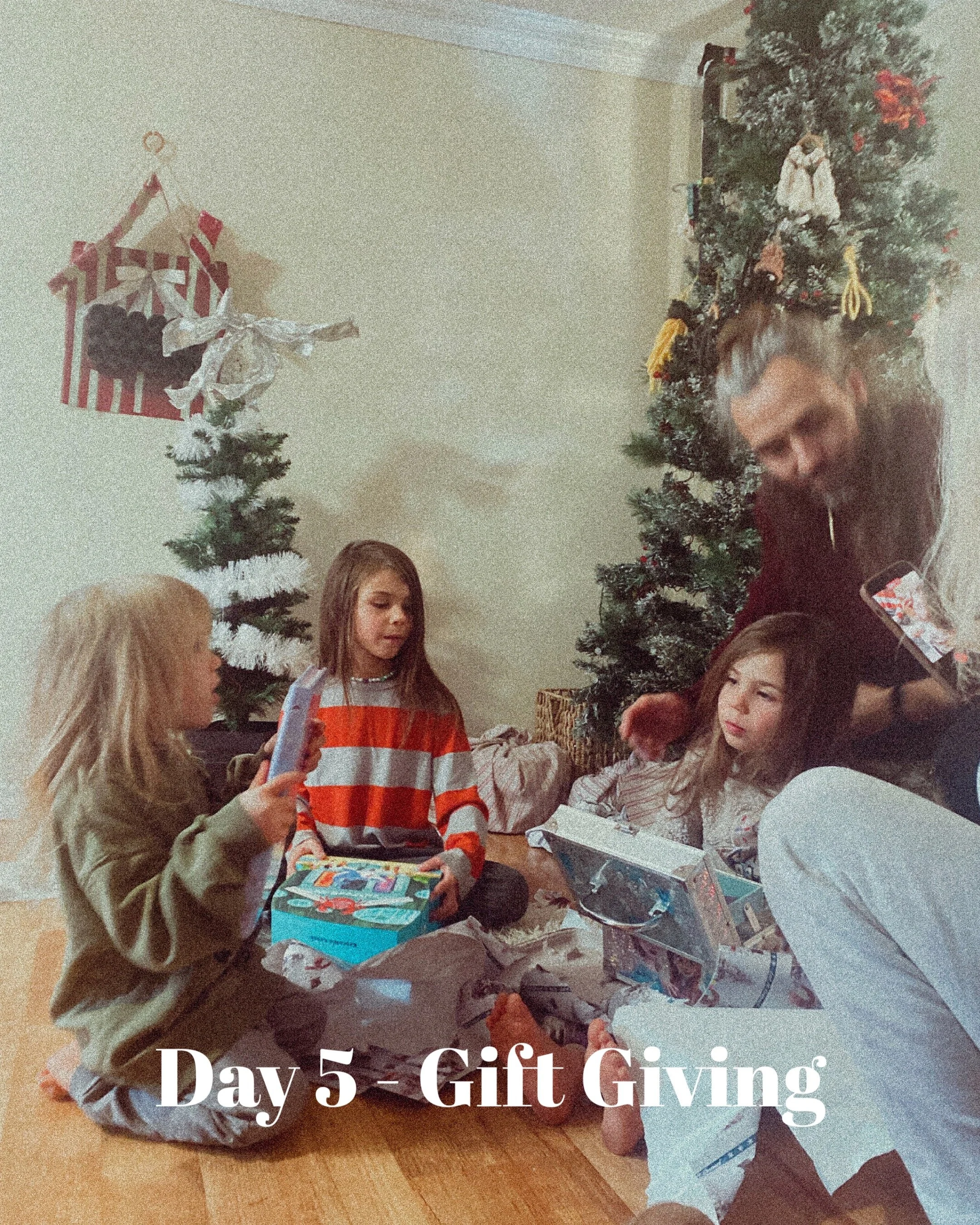
Day 5: Gift Giving Day/Rune and Divination (December 25) Winter gift-giving long predates modern Christmas. At Saturnalia, held between December 17 and 23, Romans exchanged small tokens like candles and figurines as signs of goodwill.
A few days later, on December 25, Romans honored Sol Invictus, the “Unconquered Sun,” whose rebirth symbolized renewed strength, generosity, and communal celebration.
Give a meaningful gift such as something baked or handmade.
Donate to a cause or support a small business.
Practice a random act of seasonal kindness.
Wrap gifts with natural materials like twine, dried oranges, or sprigs of pine.
Rune & Divination
**While we don’t have direct evidence that rune casting was part of the original Yule rituals, it was a liminal time when oaths were made, when the Wild Hunt took place, and people looked for omens for the coming year. And, divination was a part of that. Here’s how to read the runes if you haven’t done so before.
After all, runes weren’t just an alphabet for the Norse. They were sacred symbols, carved with intention and imbued with power. According to myth, Odin suspended himself from Yggdrasil, the World Tree, for nine nights in the quest for wisdom. In doing so, he was able to grasp the runes and they told him the secrets of language, magic, and fate.
Craft Your Own Runes. Use wood slices, clay, found antlers, or stone to create a set of Elder Futhark runes by painting or carving the symbols into each.
Pull Runes for the Year Ahead. Ask: What am I being called to learn? What must I release? And any other questions coming to your mind. Pull a single rune or a three-rune spread and reflect on its message.
Begin a Divination Journal. Record your rune pull, any signs you notice that day, and your dreams from the night before. We have journals in our shop that work well for this.
Try Other Forms of Divination (Optional). If runes aren’t your go-to, this is still a time of year to work with divinatory tools; tarot, angel cards, pendulum, tuning forks, astrology, numerology, palmistry, spirit guides, channeling, mediumship, crystal work, etc
Day 6: Odin/The Wild Hunt (December 26)
Odin is a primary figure associated with Yule in later Norse and Germanic folklore. During midwinter, Odin often rode at the head of the Wild Hunt, a ghostly procession of the dead and otherworldly beings who swept across the winter skies. In later Scandinavian traditions, children left hay, straw, or carrots in their boots as offerings for Sleipnir, Odin’s eight-legged horse. (and, yes, this is one reason Santa has eight reindeer.) He was also the Wanderer, when he moved through the world cloaked and unrecognizable, testing hospitality and rewarding those who practiced it.
These winter motifs (an otherworldly rider, a discerning gift-bringer, and offerings left in shoes) shaped early Dutch Sinterklaas customs. These later contributed to the Santa Claus figure: a supernatural winter being who rewards those for good behavior.
Spend an hour studying a mystical topic to honor Odin’s pursuit of knowledge.
Place evergreen branches, holly, or juniper at doors and windows for protection during the Wild Hunt.
Leave a symbolic “clear path” for the Wild Hunt by dimming outdoor lights and lighting one lantern.
Shut all windows, doors, and cloak mirrors before nightfall.
Leave hay, apples, or carrots outside or in a boot near your fireplace or bed as an offering for Sleipnir.
Leave a treat, snack, something for messengers and delivery workers
Day 7: Årsgång/ Yule Lads (December 27)
In rural Sweden, there’s a practice called årsgång meaning the yearly walk. You walk alone and in silence. According to folklore this is a time to glimpse into your future, the future, listen and ask for the meaning in all you experience, don’t speak with anyone but your cells. While the Yule lads were originally mischievous household spirits with names like Door-Slammer, Spoon-Licker, and Sausage-Snatcher.
These trickster figures embodied winter’s unpredictable nature and their mother, Grýla, was a fearsome ogress who punished lazy or greedy children, reflecting the harsh realities of winter survival. People didn’t make offerings or rituals to them. Instead, families used their stories to teach children winter safety and the importance of household chores.
Grýla warned against wandering into storms, while the Yule Lads’ mischief taught practical habits like securing food and closing doors.
But, you can also use this day to celebrate individuality and the playful side of midwinter folklore. Tricksters remind us that imperfection is part of being human and laughter is essential, especially during the darkest days of the year.
-Tell their tales as a way of carrying on the mythology and instilling life skills and winter survival tips.
- Take a silent walk in nature and pay attention to your thoughts and surroundings. - Reflect on your path and the journey ahead.
Day 8: Volunteer, Service/Cold Gods (December 28)
In many regions, households set aside food for the poor, travelers, or anyone in need. This aligns strongly with Norse and broader Germanic values of hospitality and guest-right, where offering warmth, food, and safety to strangers was considered both honorable and necessary for survival. Celebrate the gods and goddesses of winter.
Connect with the cold then toast to the gods! Leave offerings ❄️
Donate time, money, or items to charity or directly to someone in need.
Help a neighbor with an errand or small task such as shoveling their driveway or sweeping their steps. Or offer one hour of a skill you have (editing, babysitting, tech help).
Bake something to share with coworkers, friends, or those in need.
Perform one act of service without telling anyone.
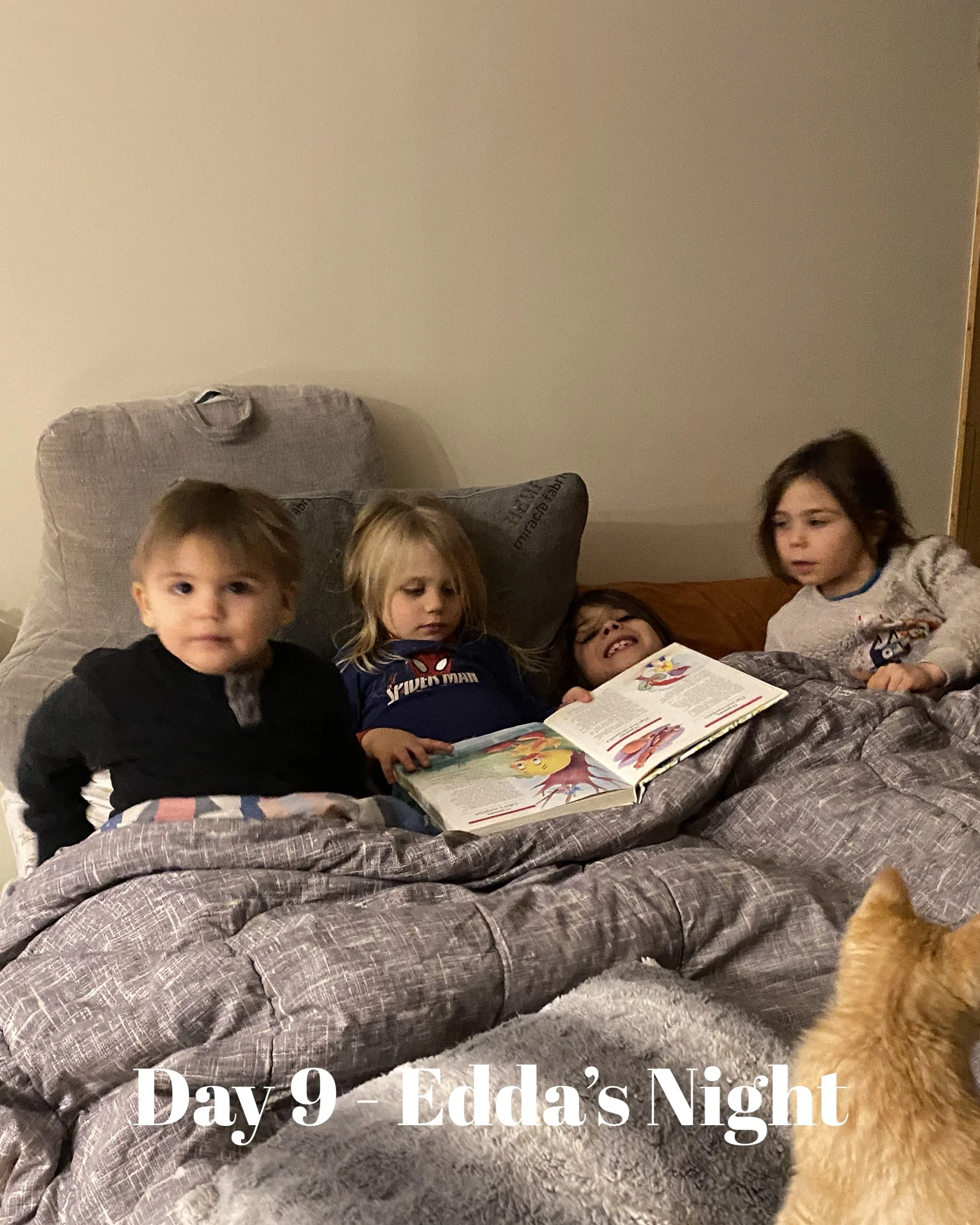
Day 9: Edda’s Night/The Deer Mother (December 29)
The Deer Mother she is not a traditional part of Yule. But, she can represent the courage it takes to move through winter and the ability to navigate cold, dark times while still carrying light. A guide, protector, and bringer of light. In several circumpolar stories, she is the one who carries or lifts the returning sun in her antlers at midwinter. It’s a symbol rooted in real reindeer biology, since female reindeer keep their antlers through the entire winter while males shed theirs in autumn.
This ecological reality also leads to a fun observation: if the reindeer pulling Santa’s sleigh have antlers in December, they would all be female reindeer.
Edda’s night; people gathered to share tales of gods, monsters, and hero’s. They passed down myth, history, and values through spoken word. We now call this folklore or mythology.
Share a myth in your own words. Share a passage from the Poetic Edda, or your favourite Norse saga.
Make a small offering of oats or seeds outdoors for the squirrels and birds in honour of the deer mother.
Draw or paint your version of the Deer Mother.
Journal about where you need courage and listen to see if the Universe has guidance for you.
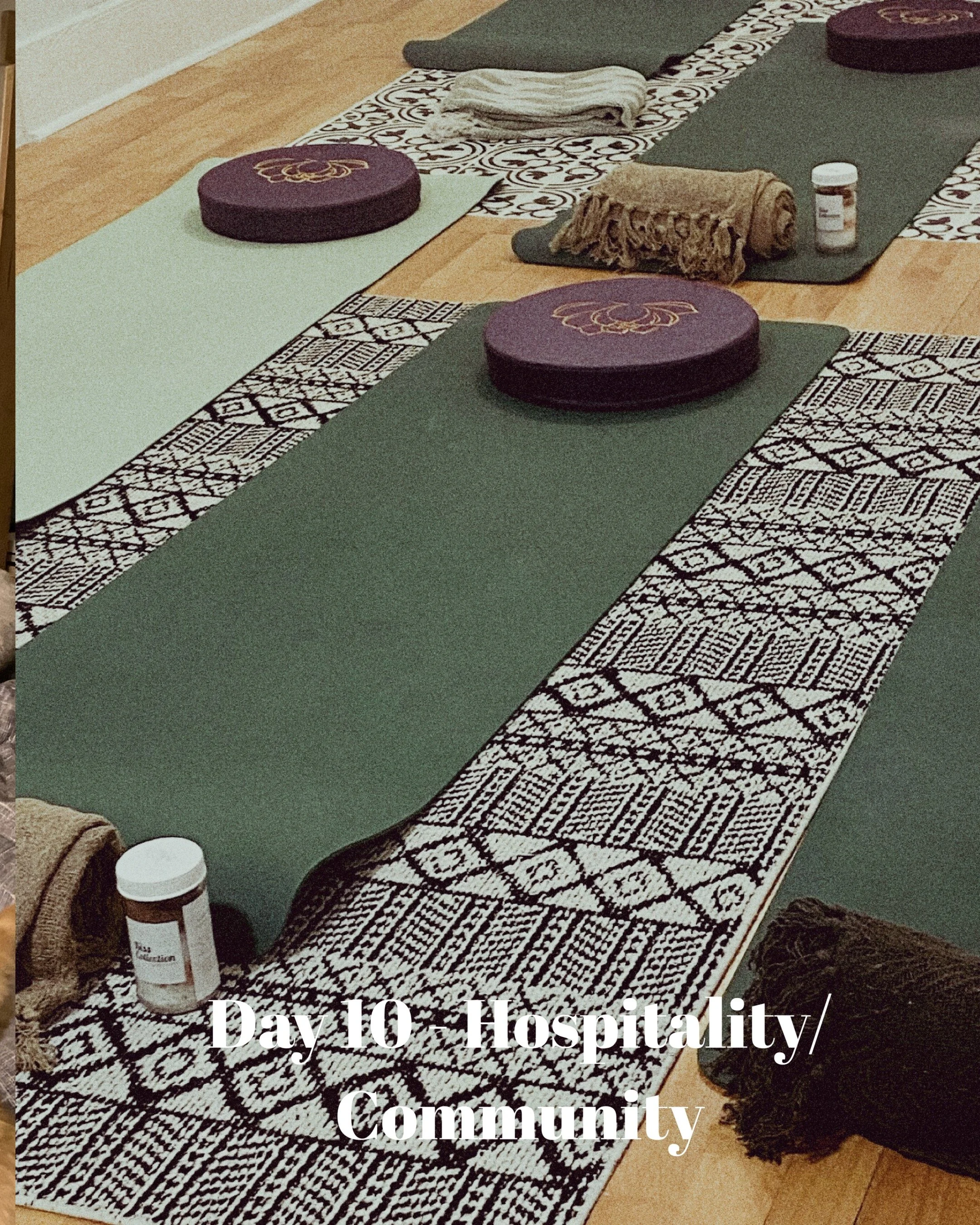
Day 10: Hospitality, Community, Saturnalia (December 30)
During those harsh Nordic winters, sharing food, warmth, and shelter could mean the difference between life and death. Yule was a time of community feasting and giving. Even in lean times, offerings were made, and generosity was expected to neighbors, travelers, and the less fortunate. Saturnalia was ancient Rome’s most famous midwinter festival; defined by feasting, role reversal, public joy; masters served servants, people crowned mock kings, gambling was allowed, and social rules loosened. For eclectic Yule this day honoured shared celebration, play, and joy!
Consider inviting someone to join your feast, especially someone who might otherwise be alone. Or dropping off food or goods for those who might need it.
- Connect with loved ones and share stories or gifts.
-Wear something playful or unexpected.
-Swap clothes with a family member/housemates.
-Crown a lord and lady of play for the day and night.
- Practice acts of kindness and generosity.
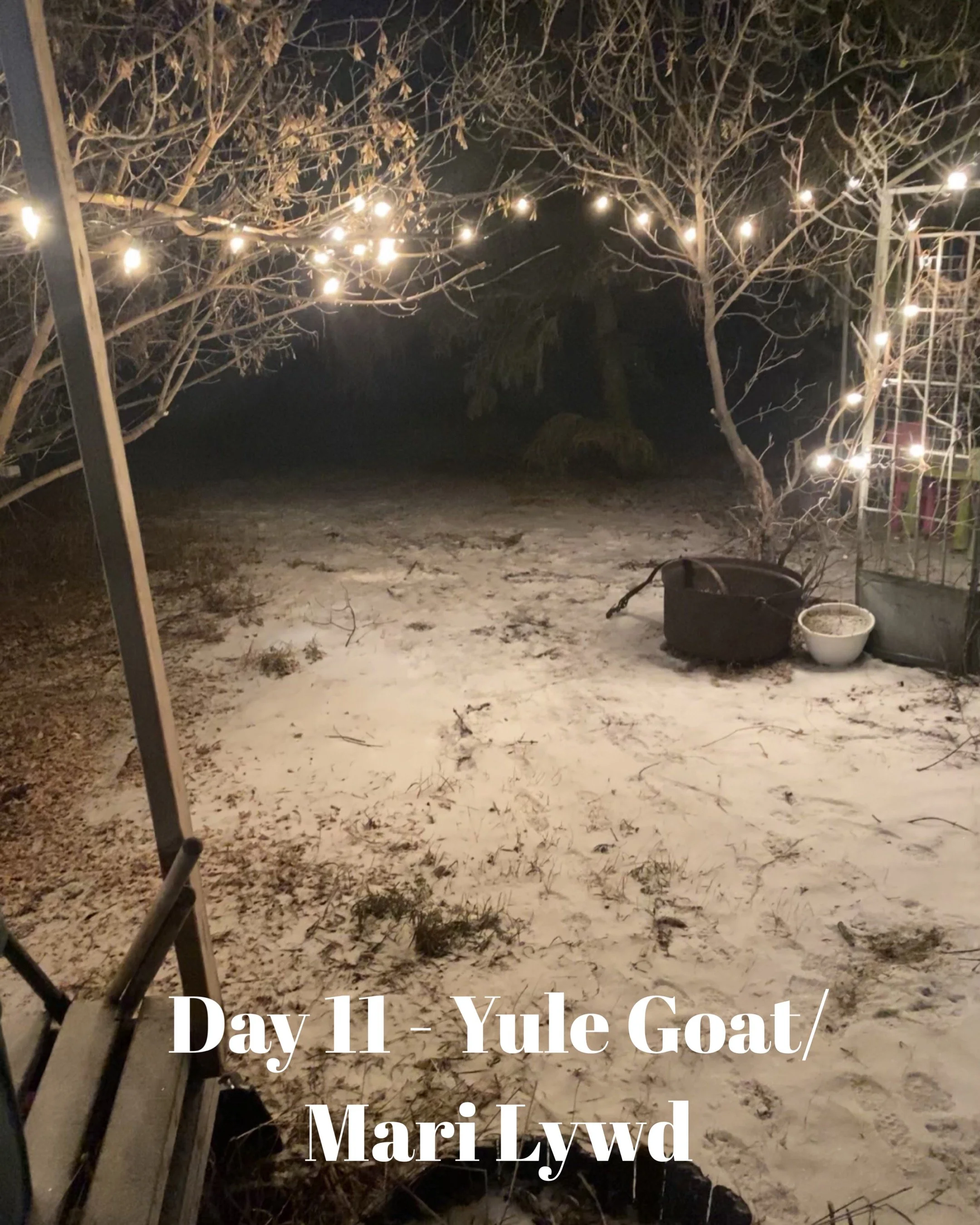
Day 11: The Yule Goat/Mari Lwyd (December 31)
The Yule Goat (Julebukk / Julbocken) has ancient roots in Nordic tradition, though its exact origins are tangled in myth and folk practice. Representing the two magical goats that pulled Thor’s chariot, the turning of the agricultural year, by the 17th century, the goat took on a rowdier role in Scandinavian Yule celebrations. In the Julebukk tradition, groups of costumed revelers, sometimes wearing goat masks or horns, would roam from house to house performing songs, telling jokes, or playfully demanding food and drink. It was sort of like caroling mixed with guising.
Eventually, the Yule Goat transformed into a gift-bringer in parts of Scandinavia and today, you’ll find straw goat ornaments (Julbocken) decorating hearths and doorways as a symbol of both protection and mischief.
Mari Lwyd ( grey mate) is one of Wales’ most distinctive midwinter traditions. She’s a haunting figure made from a horse skull, mounted on a pole decorated in white cloth, bells, ribbons, and whistles. She’s a winter visitor from the Otherworld. She doesn’t come alone she’s arrives with a group of singers where the visitors and household tarde clever verses, jokes, or challenges. If the household wins they show their strength, if they lose Mari is allowed to enter to bring luck, revelry, and a bit of joyful chaos.
-Honour these origins through the importance of boundaries and thresholds. Not everyone is allowed into your home or inner world, even if it wants to come in.
-Hang bells, evergreen over your doorway for protection
-Clear, cleanse, and protect your space
-Play Julebukk. Secretly deliver a small gift or treat to a neighbor, anonymously if you can. The spirit of this tradition is mischief combined with generosity.
-Add a goat and Mari figure or drawing for your Yule altar
Day 12: Nornir /Fate Day/Hogmanay (January 1)
The Nornir are essentially the Fates of Norse mythology. There is Urðr (What Has Been), Verðandi (What Is Becoming), and Skuld (What Must Be). They live at the base of Yggdrasil where they carve runes into the roots of the World Tree and weave the threads of destiny for the gods and mortals.
Now, there’s no known Norse festival for the Norns at Yule, but they are closely tied to turning points. It’s said that at each birth, they arrive to shape that person’s fate. And closing Yule celebrations with a day dedicated to fate feels fitting.
Hogmanay is Scotland’s winter New Year festival—it’s a blend of older Celtic midwinter customs and layer Scottish folk traditions. It’s roots lie in year-end pagan rites of purification, order, fire, and good fortune with the intention to ensure a strong foundation for the new year.
-Homes swept clean, fireplace tended, debts settled, and anything representing old resentment or disorder gets cleared out. Fire ceremonies, communal signing, ringing of bells help mark the transition from one cycle to the next
-Thread the Past, Present, and Future. Create a small thread charm or braid with three colors to represent your timeline. What you’ve learned from what has been, what is present now, and what you are stepping into or what you hope will come. Place it on your Yule altar, wear it as an amulet, or tuck it into a spell jar or your grimoire.
-Visualize What’s Next. One of the most powerful tools out there is the power of visualization. Take the time on this day to meditate on and visualize your future. Don’t just see it in your mind’s eye. Hear it, imagine what it feels like, smells like, what the emotions of the day are. Place yourself as much as you can in that experience.
-Finish the Festival With an Oath. Speak one last oath to close the festival. This can be a promise to yourself or to the gods about how you will walk forward into the new season or the new year.
Are the 12 Days of Yule historically accurate?
Not in the structured, day-by-day way they’re presented today. Historical Yule (Jól) was a midwinter festival that lasted several nights, centered on feasting, sacrifice, oath-taking, and community rites. There is no medieval Norse source assigning specific rituals to twelve consecutive days.
The modern “12 Days of Yule” calendars are contemporary Pagan creations inspired by historical themes, folklore, Norse, Celtic, seasonal customs.
*Website’s sourced*
https://www.pagangrimoire.com/the-12-days-of-yule-norse/
https://www.pagangrimoire.com/12-days-of-yule/